
Last updated 14 June 2026

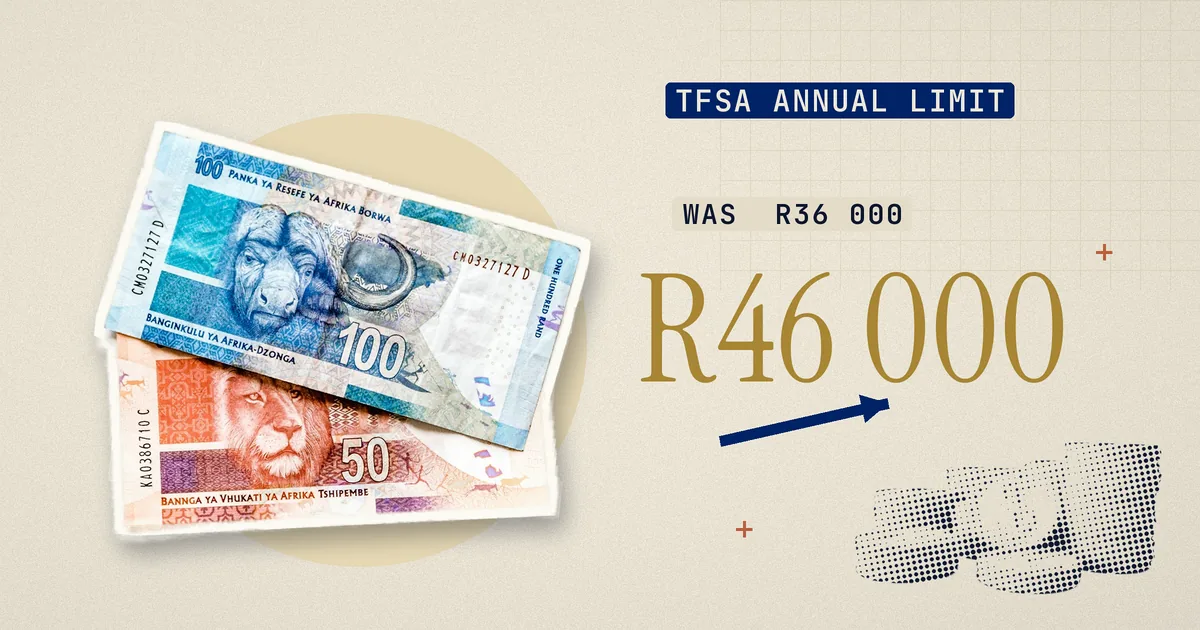
The Minister of Finance announced today (25 Feb 2026), in the 2026 Budget Speech, that the annual TFSA contribution limit will increase from R36,000 to R46,000 for the 2026/2027 tax year. The lifetime limit remains unchanged at R500,000.
This is the first increase to the TFSA annual limit since 2020, when it went from R33,000 to R36,000. The change takes effect from 1 March 2026.
A higher limit only matters if you actually use the account. Here is how to actually build the thing.
What does the new TFSA annual limit mean
Under the old R36,000 annual limit, it took 13.9 years to reach the R500,000 lifetime cap if you maxed out your contributions every year. Under the new R46,000 annual limit, it takes 10.9 years to hit the cap. That’s 3 years faster.
If you contribute the full R46,000 every year starting in March 2026, you’ll reach the R500,000 lifetime limit by around January 2037. Under the old limit, you wouldn’t have hit it until around 2040.
Most people contribute to their TFSA monthly rather than as a lump sum. Here’s how the numbers break down:
Old limit: R36,000 per year = R3,000 per month. New limit: R46,000 per year = R3,833 per month. That’s an extra R833 per month you can now contribute. If you’ve been maxing out your TFSA at R3,000 per month and you have the cash flow to increase it, you can now put in R3,833 per month without hitting the annual limit.
What If You’ve Already Contributed This Year
The 2026/2027 tax year starts on 1 March 2026. If you’ve already contributed some money to your TFSA between 1 March 2025 and 28 February 2026, that counts against the old R36,000 limit for the 2025/2026 tax year. The new R46,000 limit only applies to contributions made from 1 March 2026 onwards.
Example: You contributed R36,000 between March 2025 and February 2026; that’s your full limit for the 2025/2026 tax year. From 1 March 2026, you get a fresh R46,000 limit for the new tax year. If you only contributed R20,000 during the 2025/2026 tax year, you can’t roll over that unused R16,000 into the next year. Each tax year is separate. You either use it or lose it.
What Happens If You Go Over the Limit
If you contribute more than R46,000 in a single tax year, SARS charges you a 40% penalty on the excess amount.
Example: You accidentally contribute R50,000 in the 2026/2027 tax year. That’s R4,000 over the limit. SARS will charge you 40% of R4,000, which is R1,600 as a penalty.
The same 40% penalty applies if you exceed the R500,000 lifetime limit.
Your TFSA provider should block contributions that would push you over the annual limit, but mistakes happen. If you have TFSAs with multiple providers, you need to track your total contributions yourself. SARS doesn’t send you a warning before charging the penalty. Cause frankly, why would they miss out on free money, right?
How does the new TFSA limit affect my returns?
Reaching the R500,000 cap 3 years faster means your money has 3 fewer years to compound inside the TFSA structure before you hit the limit. Let’s compare two scenarios, assuming a 12% average annual return:
Scenario 1: Old R36,000 limit over 13.9 years. You contribute R36,000 per year. After 13.9 years, you’ve put in R500,000. At 12% annual returns, that R500,000 grows to approximately R980,000 by the time you max out the contributions.
Scenario 2: New R46,000 limit over 10.9 years. You contribute R46,000 per year. After 10.9 years, you’ve put in R500,000. At 12% annual returns, that R500,000 grows to approximately R820,000 by the time you max out.
The faster contribution timeline means you have less time for compound growth during the contribution phase. You reach the cap with about R160,000 less in your account.
But here’s what matters: once you hit the R500,000 contribution cap, the money keeps growing tax-free. After another 3 years at 12% returns, the R820,000 from scenario 2 grows to about R1.15 million. The R980,000 from scenario 1 grows to about R1.37 million.
So yes, the longer timeline gives you more compound growth during the contribution phase. But both scenarios end up in similar places after the same total time period. The real benefit of the TFSA is the tax-free growth after you stop contributing, not just during the contribution phase.
Who Benefits Most from This Change
Higher earners with strong cash flow. If you were already maxing out R36,000 per year and you have extra cash available, you can now accelerate your path to the R500,000 cap by contributing R46,000 instead.
People who got a late start. If you only started your TFSA in the last few years, this change lets you catch up faster. Instead of taking 13.9 years to max out, you can do it in 10.9 years.
Anyone worried about future limit decreases? There’s no guarantee the limits will stay at these levels forever. Contributing more now, while the limit is R46,000, locks in those contributions. If the limit drops in future years, you’ll have already banked more into your TFSA.
Who This Doesn’t Help
People already at the R500,000 lifetime cap: If you’ve already contributed R500,000 total over your lifetime, this change doesn’t affect you at all. You can’t contribute any more money, regardless of what the annual limit is.
People who can’t afford R3,833 per month: If you were already struggling to contribute R3,000 per month, the higher limit doesn’t change anything for you. You contribute what you can afford. The limit is just the maximum allowed, not a target you have to hit.
People with irregular income: If your income varies a lot month to month, the higher annual limit gives you more flexibility to make larger contributions when you have good months. But it doesn’t fundamentally change your investment strategy.
Should You Increase Your TFSA Contributions?
That depends entirely on your financial situation. Here are the questions you should ask before increasing your TFSA contributions:
Do you have an emergency fund? If you don’t have 3 to 6 months of expenses saved in an accessible account, you should consider an emergency fund. The TFSA can be accessed without penalty, but you lose that contribution room permanently when you withdraw. An emergency fund should sit in a money market or savings account, not in your TFSA. Most people misuse a TFSA because they don’t have an emergency fund.
Are you maxing out your retirement annuity? If you’re getting a tax deduction on RA contributions because you’re in the 31%, 36%, or 41% tax bracket, that might give you better value than the TFSA, depending on your situation. The RA gives you a tax break now. The TFSA gives you tax-free growth later. A financial planner can help you figure out which matters more for your specific circumstances.
Is the extra R833 per month sustainable? Don’t increase your contributions if it means you’ll run short on cash in 3 months and have to withdraw from the TFSA to cover expenses. That defeats the entire purpose. Only commit to R3,833 per month if you’re confident you won’t need that money before retirement or whatever goal you’re saving for.
Do you have high-interest debt? If you’re carrying credit card debt at 20% interest or personal loans at 15%, paying those off gives you a guaranteed return that’s higher than most investment returns. The TFSA should come after high-interest debt is cleared.
How to Adjust Your Monthly TFSA Debit Order
If you’ve decided to increase your contributions, here’s how to do it:
Step 1: Log in to your TFSA provider’s platform. This might be EasyEquities, your bank, or whoever you opened your TFSA with.
Step 2: Find your recurring debit order or monthly contribution settings.
Step 3: Increase the monthly amount from R3,000 to R3,833, or whatever amount works for you up to the R46,000 annual limit.
Step 4: Make sure the new debit order doesn’t start until 1 March 2026 or later. Contributions before 1 March still count against the old R36,000 limit for the current tax year.
Most platforms will automatically prevent you from exceeding the annual limit, but double-check if you have TFSAs with multiple providers. You need to track your total across all accounts.
Possibility of the TFSA lifetime limit increasing
The TFSA was introduced in 2015 with a R30,000 annual limit and a R500,000 lifetime limit. That lifetime limit has never changed.
If you adjust for inflation from 2015 to 2026, that R500,000 should probably be closer to R750,000 or R800,000 to maintain the same real value. But the National Treasury hasn’t increased it.
Use the Inflation Calculator to check the actual figures.
The argument for keeping it at R500,000 is that the TFSA is meant to be a tax incentive for middle-income earners to save, not a tax shelter for wealthy individuals. Keeping the lifetime cap low ensures it benefits a broad base of savers without creating a massive revenue loss for SARS.
The argument for increasing it is that R500,000 in 2026 buys a lot less than R500,000 did in 2015. Inflation has eroded the real value of that cap. If the goal is to encourage long-term savings, the cap should at least keep pace with inflation.
For now it’s staying at R500,000! Whether that changes in future budget speeches remains to be seen.
What This Means for TFSA Investors in 2026
The increase from R36,000 to R46,000 is good news if you have the cash flow to take advantage of it. You can max out your TFSA 3 years faster, which means you hit the lifetime cap sooner, and everything after that is pure tax-free compound growth.
But it doesn’t change the fundamental strategy. You still want high-growth ETFs. You still want broad diversification. You still want to stay invested through market volatility. You still want to avoid withdrawing unless necessary because you lose that contribution room permanently.
The limit increase just lets you get to R500,000 faster if you have the money available. If you want to model what your TFSA could look like under the new R46,000 annual limit, use a TFSA calculator and plug in R3,833 per month for 10.9 years at different return assumptions. See what the numbers look like. Then decide if increasing your contributions makes sense for your situation.
Not Financial Advise
If you’re not sure whether to prioritise your TFSA, your retirement annuity, paying off debt, or building an emergency fund, talk to a certified financial planner. They can look at your full financial picture and tell you where that extra R10,000 per year should actually go.
This article is for informational purposes only and does not constitute financial advice. Consult a certified financial planner before making investment decisions about your TFSA or any other investment vehicle.