
Last updated 14 June 2026

Estimated reading time: 14 minutes
Table of contents
- First, What Is the Nasdaq 100 ETF?
- The Historical Case: This Index Has Been a Machine
- The AI Argument: Why Everyone Is Excited Right Now
- The Counterargument: Who Is Actually Paying for All This?
- The Concentration Problem: You Are Not as Diversified as You Think
- The Dot-Com Warning: This Has Happened Before
- The Tariff Risk
- The Currency Factor: The Hidden Return Booster (and Trap)
- Is Nasdaq 100 A Good Buy?
- The Number That Changes Everything
I am not a financial advisor. This article is for educational purposes only and should not be taken as personal financial advice.
The question is everywhere right now. OpenAI, Google, Nvidia, Anthropic, Meta, and more. Everyone is watching the AI race and thinking: Should I put my TFSA money into the Nasdaq 100?
Short answer: it can, but only as one slice of a balanced TFSA. The ebook shows you where something like this fits, and where it does not.
It is a fair question, and I want to give you a proper answer that is researched. Let me show you what the numbers actually say, what the risks actually are, and how to think about this as someone sitting in Azania with a R46 000 annual TFSA limit.
First, What Is the Nasdaq 100 ETF?
The Nasdaq 100 is an index made up of the 100 largest non-financial companies listed on the Nasdaq stock exchange in the United States. Technology makes up roughly 50% of it. When people talk about buying the “Nasdaq 100 ETF” in Azania, they are usually talking about the Satrix Nasdaq 100 ETF.
The companies you own when you invest in the Nasdaq 100 include Nvidia, Apple, Microsoft, Amazon, Meta, Alphabet, and Netflix, among others. Seven companies, often called the “Magnificent Seven,” make up roughly 40% of the entire index. Apple sits at about 7.61%, Nvidia at 8.39%, and Microsoft at 5.7%.
You are not buying 100 evenly balanced companies but a top-heavy index where a handful of giants drive most of the movement.
Keep that in mind. We will come back to it.
The Historical Case: This Index Has Been a Machine
Let me show you what the Nasdaq 100 has actually done over the years, because the numbers are staggering.
The Satrix Nasdaq 100 has returned an average of 22.47% since its launch in 2018. In the past 5 years, it has returned an average of 15.51%. The data was pulled from this fund fact sheet. It is worth noting that all the reported returns are under the benchmark Satrix set for this ETF, which is still impressive.
Its highest annual is 57%, and its lowest is 0.81%. Some months are extremely green, while others are extremely red; you just need to know the type of ride you’re in for because it can be a roller coaster.
But here is what makes the TFSA so powerful for something like this: because there is no tax on gains, you are never tempted to sell “before the tax hits.” Your money sits. It compounds. And if you stay in through the bad years, the good years more than compensate.
The AI Argument: Why Everyone Is Excited Right Now
Let me be honest with you. The excitement around AI is real. The money being poured into it is real. The companies doing the pouring are all sitting inside the Nasdaq 100.
NVIDIA, the company that makes the specialised chips that power large AI models, has seen its data centre revenue reach $51.2 billion in a single quarter, a 66% increase year over year. The company controls an estimated 90% of the AI chip market. Big Tech companies, including Microsoft, Amazon, Meta, and Alphabet, are projected to collectively spend over $600 billion on AI infrastructure in 2026 alone. That is a 36% increase from 2025, and roughly 75% of that spending goes directly toward AI.
To put it differently, the companies building and buying AI infrastructure are almost entirely Nasdaq 100 companies. When Microsoft spends $140 billion on AI this year, that money flows through Nvidia, through cloud infrastructure, through software. Most of it stays inside the index.
Google has launched its own TPUs (custom AI chips) to reduce dependence on Nvidia. Anthropic surpassed significant revenue milestones in 2024 and 2025, and while Anthropic itself is not publicly listed, the hyperscalers funding it, Amazon and Google, are in the index. OpenAI is backed by Microsoft, which is in the index. Meta is building its own AI infrastructure aggressively.
The AI buildout is a Nasdaq 100 story. If you believe AI is genuinely transforming how the world works, the Nasdaq 100 is one of the most direct ways to participate in that story as a retail investor in Azania.
But I want you to think about something.
The Counterargument: Who Is Actually Paying for All This?
Here is a question that does not get asked enough: Is AI profitable yet?
The Big Five hyperscalers are spending $602 billion on AI infrastructure in 2026, much of it funded through debt. J.P. Morgan analysts have identified what they call a “Revenue Gap”: the industry needs to generate $650 billion in annual revenue just to justify the level of capital expenditure being spent. That gap has not been closed.
AI is expensive to build and expensive to run. The cost of training large language models, the cost of running them at scale, the cost of the energy required for the data centres, all of it is enormous. The upside exists. The runway is there. But we are still in the phase where companies are spending ahead of the returns.
Companies like Workday, Amazon, Microsoft, and Salesforce are simultaneously cutting tens of thousands of jobs and citing AI as the reason. In 2025, approximately 55,000 US job cuts were directly attributed to AI. Microsoft cut 15,000 jobs in the same year it reported 13% revenue growth. Salesforce cut 4,000 customer support roles, with its CEO stating AI now handles half the company’s work. And if you’ve applied on Workday recently, you’ll notice that their system is actually better now, is it thanks to AI?
The jobs are going. The revenue from AI replacing those jobs has not fully arrived yet.
This matters to you as an investor because it tells you something about the near-term earnings picture. These companies are betting that the productivity gains from AI will eventually generate more than they are spending. That bet is almost certainly correct over the long run. But “almost certainly correct over the long run” and “will not drop 30% in 2027” are two very different statements.
The Concentration Problem: You Are Not as Diversified as You Think
I want to revisit this point, because it is the one risk I see most people dismiss.
When you buy the Nasdaq 100, you get 100 companies. That sounds like diversification. But the Magnificent Seven – Alphabet, Amazon, Apple, Meta, Microsoft, Nvidia, and Tesla – make up approximately 40% of the entire index. NVIDIA’s weight alone jumped from under 2% to nearly 8.7% in just a few years.
The top 10 holdings collectively make up about 47% of the fund. This means that if Nvidia drops 20% tomorrow, the entire index loses roughly 1.7% before any other company moves.
This is exactly what happened in January 2025 when the Chinese AI startup DeepSeek released a model that claimed to match the performance of leading US models at a fraction of the cost. NVIDIA fell sharply. The Nasdaq 100 fell with it. The whole narrative that “only Nvidia’s expensive GPUs can do this” was being questioned in real time.
The DeepSeek moment was a preview of a real risk. If competition from China, from Google’s TPUs, or from alternative chip architectures erodes Nvidia’s dominance, the Nasdaq 100 feels it immediately and painfully.
The Dot-Com Warning: This Has Happened Before
In 1999, the Nasdaq rose 86% in a single year. Everyone wanted in. Tech stocks were going to change the world. Everyone who questioned it looked like they were missing the obvious.
Then came March 2000. The Nasdaq 100 fell 78% from its peak over the following two and a half years, wiping out over $5 trillion in market value. The index did not reclaim its March 2000 high until April 2015. That is fifteen years of waiting to break even.
If you had invested R100 000 in the Nasdaq 100 in February 2000, by October 2002, you would have been sitting on about R22 000. You would have needed to stay invested through that entire fifteen-year recovery to see your money return. Most people did not.
The dot-com crash was not caused by bad companies. It was caused by companies with real potential that were priced as though that potential was already certain. The same structural dynamic exists in AI today, even if the fundamentals are stronger. Goldman Sachs Research has noted that today’s leading tech companies are valued at less extreme levels than their 2000 equivalents, and that the fundamentals are more solid. But bubble behaviour in pockets of the market, particularly in more speculative AI-adjacent stocks, has parallels to 1999.
I am not saying we are in a bubble; I am saying that history rewards the investor who accounts for the possibility rather than dismissing it.
The Tariff Risk
The USA, under Trump’s second administration, has introduced sweeping tariffs: 145% on Chinese imports, and broad tariffs on most trading partners. On “Liberation Day” in April 2025, markets across 77 countries posted significant negative returns, with the US market itself dropping over 10% in that event window. The Nasdaq 100 suffered a 15% drawdown before recovering by October.
Why does this matter for tech? Because the big Nasdaq 100 companies rely on global supply chains. Apple manufactures a large portion of its products in China and other tariff-affected countries. Qualcomm, AMD, Intel, and others face restricted access to Chinese markets. Higher component costs squeeze margins. Retaliatory tariffs from China can shut Nasdaq 100 companies out of one of the world’s largest consumer markets.
Tariffs also push inflation higher, which keeps interest rates elevated for longer. Higher interest rates reduce the present value of future earnings. Growth stocks, which the Nasdaq 100 is built almost entirely from, are more sensitive to interest rates than almost any other asset class. When rates go up, high-multiple tech stocks get punished first.
The Currency Factor: The Hidden Return Booster (and Trap)
Here is something unique to us as Azanian investors.
When you buy the Satrix Nasdaq 100, you are buying in rands and earning in US dollar terms. The actual rand return you receive is a combination of two things: the performance of the Nasdaq 100 in dollars, and the change in the rand/dollar exchange rate. This is what’s called a feeder ETF.
If the Nasdaq 100 gains 25% in dollar terms, but the rand strengthens by 10% against the dollar over the same period, your rand return is approximately 15%, not 25%. In 2025, the rand appreciated by nearly 10% against the dollar, which offset some of the dollar returns from Satrix’s global ETFs for South African investors.
The reverse is also true. When the rand weakens (as it has done structurally over most of the last 20 years), your rand returns from a Nasdaq 100 ETF are amplified. A 20% dollar gain in a year when the rand weakens 10% gives you closer to 32% in rand terms.
Historically, the rand has weakened over the long run. But the SARB Governor Lesetja Kganyago has noted that the rand is now more stable than its historical reputation suggests, and S&P upgraded Azania’s sovereign credit rating in November 2025 for the first time in nearly two decades. A more stable or strengthening rand reduces (but does not eliminate) the currency tailwind that has historically amplified rand returns on global ETFs.
You need to factor this in, honestly. It is not a reason to avoid the Nasdaq 100. But it changes the calculation you are doing in your head. To understand the inflation impact on your purchasing power over the same horizon, our inflation calculator walks through that clearly.
Is Nasdaq 100 A Good Buy?
I am not a financial advisor, so I cannot give you a yes or no, because that would be considered financial advice. I am, however, allowed to tell you that the Satrix Nasdaq 100 ETF is the best-performing ETF in my TFSA portfolio. Here’s a screenshot to prove it:
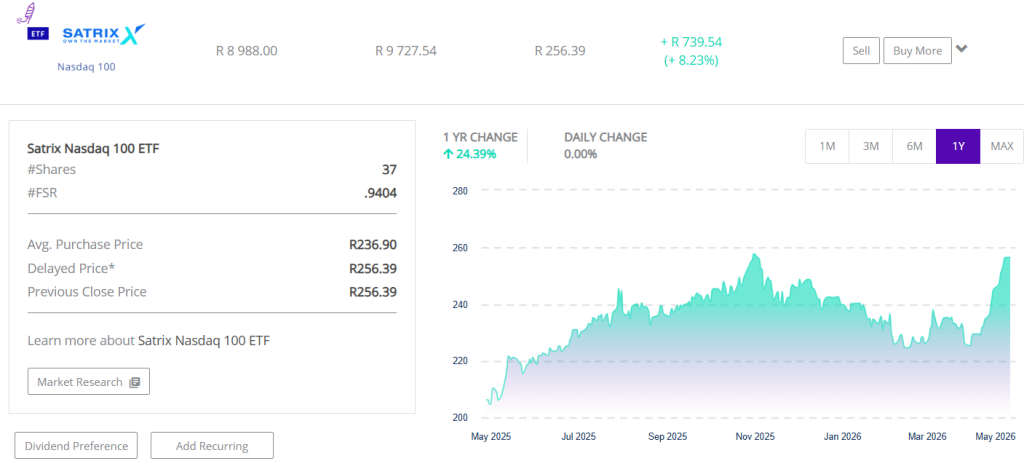
I will be increasing my position in this ETF, amongst others. Here’s why:
The companies inside the Nasdaq 100 are real businesses generating real cash. NVIDIA’s revenue grew from $27 billion in fiscal 2022 to $96 billion in fiscal 2025. Microsoft, Amazon, and Alphabet are not selling promises, but products used by hundreds of millions of people every day. I mean, every employer or employee uses Microsoft Suite, or Google Workspace, and Amazon shopping is getting big in SA, and these are just a few reasons.
The dot-com comparison only goes so far, because those 2000-era companies mostly had no earnings. These companies do.
The AI transformation is not hype in the same way the dot-com boom was hype. The infrastructure being built is real. The productivity gains are starting to show up in earnings. The companies funding all of it are inside this index.
But the concentration risk is real. The tariff risk is real. The earnings-to-capex gap is real. And the historical record shows this index can fall 30 to 78% before recovering, depending on how bad the environment gets.
If you are building a TFSA and your horizon is 15 to 20 years, a meaningful allocation to the Nasdaq 100 ETF is defensible. The TFSA wrapper means you pay no tax on the gains, and on an index that has historically returned close to 20% annualised over the last decade, that tax saving is enormous. You are letting your money grow in one of the most powerful sectors of the global economy, sheltered from Uncle Rama’s enormous tax that ends up being looted.
If I were starting out, I would not put 100% of my TFSA into the Nasdaq 100. I would hold it alongside a broader global index like the Satrix MSCI World ETF, which gives you more geographic and sector diversification, and possibly a portion in the Satrix S&P 500, which has significant tech exposure but slightly less concentration.
The Nasdaq 100 is the high-octane version. It performs brilliantly in bull markets and punishes you in corrections. The MSCI World is the more balanced engine. You can run both in the same TFSA, and many investors do. If you want a deeper breakdown of how to compare these vehicles, the piece on TFSA vs Retirement Annuity walks through the different vehicles in full.
The Number That Changes Everything
Here is a calculation I want to leave you with. And I am going to show you the working properly, because this is where most articles mislead you.
Your TFSA has a R500 000 lifetime contribution limit. At R46 000 per year, you hit that cap in approximately 10.9 years. After that point, you cannot add another rand. Your money just compounds on its own.
Here is what the numbers actually look like across different return scenarios:
| Annual Return | Portfolio when cap is hit (~10.9 yrs) | Portfolio at 20 years |
|---|---|---|
| 8% | R792 924 | R1 642 111 |
| 12% | R1 020 237 | R3 035 101 |
| 15% | R1 243 457 | R4 849 966 |
| 20% | R1 756 392 | R10 743 472 |
Total contributions in every scenario: R500 000. The rest is compounding.
At 15% annualised (well below the Nasdaq 100’s inception historical average of ~20%), your R500 000 in contributions turns into roughly R4.85 million by year 20. It’s worth noting that this doesn’t account for inflation. Use my inflation calculator to see the figures adjusted for inflation.
Now, here is what the TFSA wrapper saves you in taxes. In a standard taxable investment account, your capital gains would be subject to CGT: SARS includes 40% of your gain in your taxable income, which is then taxed at your marginal rate. At the top 45% bracket, that works out to an effective rate of 18% on the gain. For someone in a lower bracket, it is less, but it still takes a real bite. On top of that, dividends from a taxable account attract 20% dividends withholding tax. Inside a TFSA, both of those are zero. The full R4.85 million (or R10 million, depending on what the Nasdaq 100 does) is yours.
The risk is that the index does not deliver 15%. It might deliver 8%, 25%, or even drop 30% in year three, and you panic. That is the real variable in this calculation, and no calculator can control for it.
I am not a financial advisor. You need to do your own research and ideally speak to a registered financial planner before making major decisions.
But the evidence says this: if you have the time horizon, the discipline not to sell during the bad years, and the stomach for volatility, the Satrix Nasdaq 100 ETF inside a TFSA is one of the most powerful wealth-building tools available to any beginner investor in Azania.
The AI revolution is real. The companies driving it are inside this index. And Uncle Rama will not touch a single rand of your gains.
That is a powerful combination.
Yes. STXNDQ is a Section 12T qualifying investment, which means it can be held inside a Tax-Free Savings Account.
As of March 1, 2026, the annual TFSA limit increased to R46 000, up from R36 000. The lifetime limit remains R500 000. Exceed either limit, and SARS charges a 40% penalty on the excess.
STXNDQ tracks the Nasdaq 100 in US dollars, so your rand return is the dollar return adjusted for the rand/dollar exchange rate. A weaker rand amplifies your returns; a stronger rand reduces them.
No. The S&P 500 tracks 500 large US companies across all sectors. The Nasdaq 100 tracks 100 companies specifically listed on the Nasdaq, with a heavy concentration in technology. There is significant overlap (Apple, Microsoft, Nvidia appear in both), but the Nasdaq 100 carries more sector concentration and higher volatility. You can compare both on the TFSA calculator by entering different return assumptions.
As of March 2025, the total expense ratio is 0.46% per year following Satrix’s conversion of the fund to direct replication.
Run your own numbers using the Azanian Investor TFSA Calculator. Disclaimer: The Azanian Investor is not a registered financial advisor. All content is educational and should not be taken as personal financial advice. Past performance is not indicative of future returns.