
Last updated 14 June 2026

Estimated reading time: 8 minutes
Table of contents
I’ve been seeing various videos online about people’s retirement annuity (RA) returns and fees. When I looked at the comments, I realised most people don’t know the difference between a LISP RA vs Traditional RA. These are set out to achieve the same goal: ensuring you retire comfortably, but choosing the wrong one could cost you a few hundred thousand, sometimes millions. In this blog post, I’m going to break down every aspect of each as factually as possible.
It’s worth noting that this article is not financial advice, and you must speak to a licensed financial advisor before making big decisions such as changing RAs.
What is a LISP RA?
LISP stands for Linked Investment Service Provider. Think of it as an investment platform, a kind of marketplace, where you open an RA and then choose which underlying funds to put your money into. Providers like Allan Gray, Sygnia, Ninety One, and 10X all operate as LISPs.
When you open an RA through any of these platforms, you are opening a LISP-based RA. It is a unit trust investment sitting inside a retirement fund wrapper.
- The Pension Funds Act still governs it.
- All the standard RA rules still apply.
- You cannot touch the money before age 55.
- Your contributions are tax-deductible up to 27.5% of your taxable income, capped at R430 000 per year from 1 March 2026.
- When you retire, two-thirds of the fund must be used to purchase an annuity income.
What changes is the transparency and flexibility. You can see exactly what you are invested in, as well as the fees. If you want to stop contributing, you can do so without a penalty. You can reduce your contribution without anyone charging you for it. If you find a better platform, you can transfer your RA there under Section 14 of the Pension Funds Act, also without penalty.
What Is a Traditional RA?
The traditional RA is a product sold by life insurance companies such as Sanlam, Old Mutual, Liberty, and similar. When people think about opening retirement annuities, these companies come to mind. A traditional RA is governed by the same rules as a LISP RA.
The difference lies in the structure underneath.
A traditional insurance RA is a contract. When you sign it, you are agreeing to pay a specific premium for a specific number of years. The insurance company calculates the commission for your financial advisor upfront, based on your premium multiplied by the term of the contract, and they pre-fund it. They pay the advisor now and recover that cost from your premiums over time.
A financial advisor once told me that the commission they make from a traditional RA is a one-time fee, which amounts to 4 times your monthly premium, followed by a monthly percentage fee. For instance, if you sign up with a traditional RA and choose to pay R2,500 a month, the financial advisor will get R10,000 once off, then a percentage fee going forward. This can differ by company.
If you then choose to cancel your traditional RA soon after signing up, the financial advisor will need to pay back 70% of that one-time fee, with the above example, it’ll be R7,000. This is known as a clawback.
That recovery window is called the recoupment period. It typically runs for 60 months, which is five years.
If you reduce your contributions, stop paying, or try to transfer to another provider while you are inside that 60-month window, the insurance company can charge you a penalty. Remember, they already paid your advisor, and they have not finished recovering that cost from you. Changing the arrangement mid-way costs you money.
This is not illegal; it is disclosed in the policy documents, and most of us never read those documents in full, and many advisors do not go out of their way to explain it. The reason is not hard to understand. Traditional RAs pay higher upfront commission than LISP RAs do.
LISP RA vs Traditional RA: The Fee Gap Over 30 Years
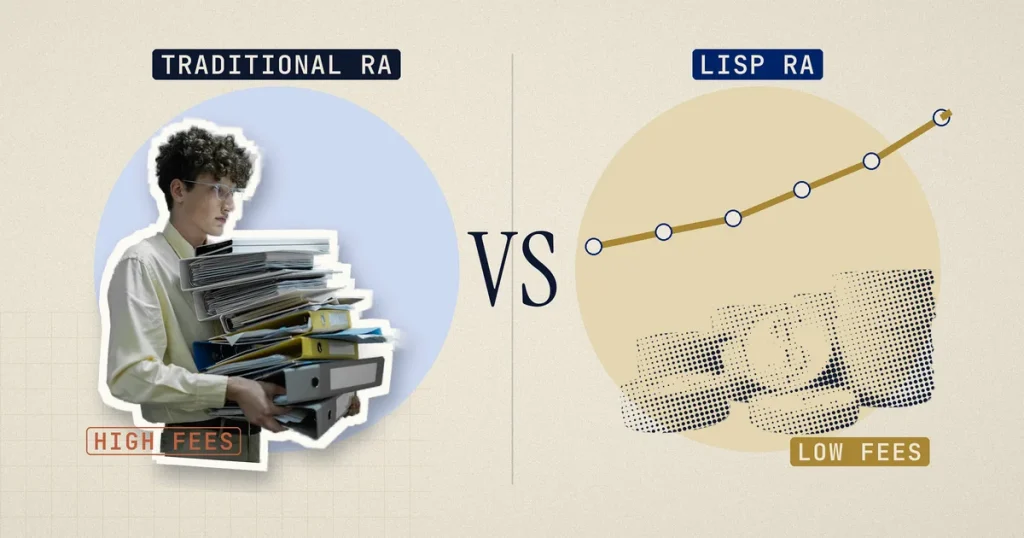
Traditional RAs commonly carry an Effective Annual Cost of around 3% per year. A LISP RA with a low-cost index tracking fund, from a provider like Sygnia or Allan Gray, sits between approximately 0.9% and 1.2% per year.
Now, suppose you invest R2 000 a month for 30 years. Assume a gross market return of 11% per year before fees. These are illustrative figures, not guaranteed outcomes, but they give you an idea of what I’m trying to demonstrate.
At 1% in annual fees, your net return is roughly 10%. After 30 years, you end up with approximately R4.5 million.
At 3% in annual fees, your net return is roughly 8%. After 30 years, you end up with approximately R2.9 million.
Same contributions. Same gross market return. The 2% fee difference costs you approximately R1.6 million over 30 years.
Which RA Can You Pause?
In Azania, life happens. Your car needs repairs. A family member needs help. You take a pay cut. This is how most of us actually live.
The structural difference between the two RA types now becomes most visible.
With a LISP RA, you can pause or reduce your contributions at any time, for any reason, without fees or penalties. Your investment stays in the fund and continues growing. You restart when you are ready. Reducing your debit order from R2 000 to R500 is a setting you change, and they don’t charge you for it.
With a traditional RA, if you are still inside the 60-month recoupment window and you reduce or stop your contributions, you face a penalty. The insurance company has a legitimate cost to recover. Your timing costs them, and they’ll quickly put the clawback into effect.
This is the real reason the comparison matters. The tax is the same. The lock-in is the same. What differs is what happens when your income changes, which for most salaried workers in Azania is not a matter of if, but when.
Regulation 28 in both RAs
Regulation 28 of the Pension Funds Act applies to all retirement annuity funds in Azania, regardless of whether they are on a LISP platform or held with an insurance company.
The regulation limits your exposure to specific asset classes inside the fund. Currently, you cannot hold more than 75% in equities, not more than 45% offshore (including Africa), and not more than 25% in property. Its purpose is to prevent you from putting everything into one asset class and exposing your retirement savings to unnecessary concentration risk.
Whether you agree with the limits or not, they apply equally across both structures. This is not a reason to choose one type of RA over the other. It is just a reality of investing in any retirement fund in Azania.
Should You Switch From a Traditional RA to a LISP RA?
I only provide education and awareness; I do not tell people what to do with their money, that’s the role of a financial advisor. In this case, you might want to consider an independent financial advisor because one that works for a traditional RA will not advocate for a LISP RA, and vice versa.
Both RA’s give you the same tax benefit. Use our RA tax refund calculator to see how much you can get back from SARS if you contribute to an RA.
If you are still inside the 60-month recoupment period of your insurance RA, transferring may trigger a penalty that cancels out the fee savings you would gain in the short term. Before you do anything, ask your insurer for the exact penalty amount in writing. Then compare it against the fees you would save on a LISP platform over the remaining years of your investment.
By the way, transferring between approved retirement funds under Section 14 of the Pension Funds Act does not trigger a tax event. You are not withdrawing the money but moving it between two approved funds. The tax man does not get involved in that transaction.
If you are past the recoupment period, or if you have a newer insurance RA that is already operating on an open-ended basis, the move might be worth investigating.
If you have not opened an RA yet and you are starting fresh today, compare both types, then compare the difference providers so that you get the maximum return on your hard-earned money.
Frequently Asked Questions
A LISP RA is a unit trust-based retirement annuity on an investment platform. It is flexible, transparent, and has no penalties for changing or stopping contributions. A traditional RA is a contract with upfront advisor commissions, a 60-month recoupment period, and potential penalties for amending the policy terms during that window.
Yes. Transfers between approved retirement funds are permitted under Section 14 of the Pension Funds Act with no tax consequences. If you are still within your insurance RA’s recoupment period, get the penalty amount in writing before deciding. Compare that cost against the long-term fee savings before you move.
Yes. Both qualify for the same SARS deductions. Contributions are deductible up to 27.5% of taxable income, capped at R430 000 per year from 1 March 2026. Growth inside the fund attracts no income tax, no dividends tax, and no capital gains tax.
Effective Annual Costs (EAC) on LISP-based RAs with index-tracking funds generally range between 0.9% and 1.2% per year. Traditional insurance RAs can carry EACs of around 3%, though this depends on the specific product and provider.
Yes. A LISP-based RA allows you to stop, pause, or reduce contributions at any time without fees or penalties. Your investment remains in the fund and continues growing until you choose to contribute again.
Yes. Regulation 28 of the Pension Funds Act applies to all retirement annuity funds in Azania, regardless of whether they are on a LISP platform or held with a life insurance company.